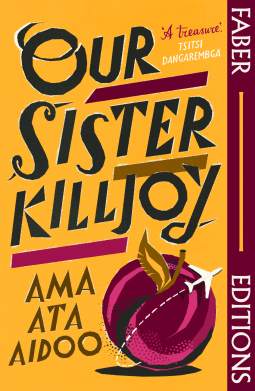
Some books resonate across generations, their themes refusing to be silenced. Ama Ata Aidoo’s Our Sister Killjoy, first published in 1977 and now reissued by Faber Editions in 2025, is one such novel. A searing critique of European imperialism, alienation, and the disillusionment of African intellectuals abroad, this book remains as urgent and thought-provoking as ever. For those who revel in literature that challenges, informs, and captivates, Aidoo’s work is an essential read.
Ayesha Harruna Attah’s foreword to this edition beautifully sets the scene and tone for the book, introducing readers to Aidoo’s legacy while providing historical and cultural context. It primes the reader for the journey ahead, offering valuable insights into Aidoo’s impact and the continuing relevance of Our Sister Killjoy.
At the heart of Our Sister Killjoy is Sissie, a sharp and observant Ghanaian woman who travels to Europe on a scholarship. Unlike many diasporic narratives that romanticise the Western experience, Aidoo flips the script—Sissie’s encounters in Germany and England are laced with disillusionment, cultural confrontation, and a deep yearning for home. The novel’s distinctive structure—blending poetry, prose, and political commentary—mirrors the disjointedness of the immigrant experience, making the reader feel Sissie’s displacement in every word.
Aidoo’s writing is masterful. Her prose is both lyrical and incisive, her wit razor-sharp. Through Sissie’s eyes, we see the absurdities of Western arrogance, the loneliness of the immigrant journey, and the moral reckoning faced by those who leave home in search of something better. The novel challenges the notion of assimilation, instead emphasising self-knowledge, resistance, and a return to one’s roots.
For those of us born into the Ghanaian diaspora, especially in the UK, Our Sister Killjoy carries an even deeper resonance. Sissie’s reflections on the immigrant experience expose the myth of Western superiority and the reality of alienation, themes that still echo in the lives of first-generation British-Ghanaians. The tension between embracing British influences while holding on to Ghanaian heritage is ever-present, making Aidoo’s message feel incredibly personal.
Moreover, Aidoo’s feminist perspective sheds light on the expectations placed on African women—both at home and abroad. Her portrayal of Sissie as a woman who rejects imposed societal norms feels especially powerful in a diasporic context where cultural expectations and Western ideologies often clash.
Reading Our Sister Killjoy in 2025 is a reminder of how relevant Aidoo’s work remains. With ongoing conversations about migration, identity, and postcolonial realities, Sissie’s story feels eerily contemporary. This book also fits perfectly into the 2025 Popsugar Reading Challenge category—‘A book where the main character is an immigrant or refugee’—but it is so much more than that. It is a feminist manifesto, an anti-colonial critique, and a love letter to Ghana, all wrapped in an evocative and innovative literary form.
For those new to Aidoo, this is an excellent introduction to her brilliance. For those revisiting her work, this reissue is a timely reminder of why she remains one of the most significant voices in African literature. Our Sister Killjoy is not just a book—it is an experience, one that demands to be felt, interrogated, and remembered.
Our Sister Killjoy is available from all good bookshops
 Elaine Adu-Poku